
AI-mediated speech-to-text usage in multilingual healthcare encounters
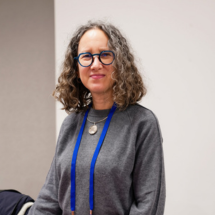
Medical communication between clinician and patient is a delicate business at the best of times. But what happens when an algorithm joins the consultation? And where do language professionals fit into this new set-up? In her presentation, Amy Dara Hochberg argued that AI-mediated speech-to-text will not put language professionals out of a job, but that their role will evolve.
As a researcher in multilingual health communication, Amy Dara’s work is informed by her lifelong profound deafness and lived experience of language barriers. She began using speech-to-text apps during the pandemic, when masks made it impossible to lip-read, and she soon noticed errors that could prove critical in healthcare settings. Imagine the potential harm of “no allergies” being transcribed as “known allergies” or vice versa.
When a patient arrives at an appointment with an app instead of an interpreter, the conversation runs through the screen: the clinician speaks, the app transcribes, machine translation follows if needed, and the patient reads or hears the result. In the best case, speech-to-text apps offer accessibility benefits for multiple groups: d/Deaf and hard-of-hearing patients, patients with limited local-language proficiency, and multilingual clinical teams, to name just a few.
But as Amy Dara demonstrated with a simple interactive experiment, the results are not always to be trusted. Many of us found that our speech-to-text apps were unable to transcribe “I am at the METM26 conference in Perugia” accurately. If the system stumbles over a single sentence in a conference room, what happens in a complex multilingual health encounter? Speech-to-text apps perform well with clear speech, common vocabulary, predictable consultations, and simple turn-taking. But they struggle with accents, medical terminology, overlapping speech, cultural references, and the meaning between the lines – in other words, with many features typical of medical consultations.
Medicine runs on records. When speech becomes data, it can be processed, transformed, and displayed. But whose version is the “official” one? Who decides if the transcription is accurate? And who is accountable if it’s wrong?
Amy Dara’s message was clear: AI cannot replace language professionals in the traditional triad of clinician, interpreter and patient. Instead, she proposed a model in which AI is supervised by a language professional with new roles: verifying terminology, continuously monitoring output, explaining the technology’s limitations, intervening when meaning changes, and documenting communication risks.
The session closed with reflection and discussion. AI tools are entering clinical practice faster than guidelines can follow – the genie is well and truly out of the bottle. With medical consultations among the most private conversations there are, can patients really rely on their AI-processed data being kept confidential? Who provides the apps, and can they be trusted with what they hear? Will the solution be for healthcare providers to develop their own in-house systems? And if apps are being used to save money and streamline processes – interpreters aren’t always available, after all – why should healthcare providers pay for language professionals to supervise them? Amy Dara’s answer was unequivocal: it’s a liability issue.
Accessibility in multilingual healthcare settings is not a nice-to-have – it’s a human right. Speech-to-text apps are undeniably faster, cheaper, and fluent in more languages than anyone in the room. But, as Amy Dara reminded us, fluency is not fidelity. Adding technology to the mix does not automatically deliver accessibility; that takes people, processes, and technology working together – and language professionals, Amy Dara argued, are the people with the expertise to catch what the machine misses.
This METM26 presentation was chronicled by Susannah Goss*.
Featured photo by METM26 photographer Giancarlo Menghini.
*Sign in to the MET website to view Susannah’s profile.