
Who’s speaking, please? Tense and speaker voice in research articles
As well as teaching academic writing to Leiden University PhD candidates in the social and behavioural sciences, Maria Sherwood-Smith freelances as an academic editor – a role in which she sees her responsibility as helping authors to communicate clearly, comply with conventions, fit in with their tribe and not overstate or downplay their findings.
An assignment to edit a research article destined for the European Journal of Psychotraumatology inspired her session. Co-authored by three Dutch academics, this article in conventional IMRAD format (Introduction, Methods, Results and Discussion) reported a study in which practitioners dealing with families affected by sibling sexual abuse were interviewed about their work. This cocktail of parameters produced some particularly vexing editorial challenges relating to verb tenses, which Maria explored, pointing out that these verb tense issues had to be addressed bearing in mind two sets of conventions: those of research articles and those relating to reported speech. Maria explained how she set to work, what motivated her amendments and why she began to doubt some of them.
Referring to a standard textbook by John Swales and Christine Feak, Maria reminded us of verb tense conventions of academic English that are taught to novice scholarly and scientific authors: use present simple for accepted truths, past simple for actions done and present perfect for signalling contemporary relevance. She also referred to my 2001 article in which I discussed the verb tense usage found in scholarly and scientific publications and argued that the present tense has a subliminal influence on readers.
Maria had analysed the changes made to the verb tenses in her editing assignment as it progressed from unedited draft through her edited version to the authors’ revision, after which it was returned to her and was then published in the scholarly journal. She found that the greatest variety in tense use in the unedited draft was in the Results section, where the authors reported on what the practitioners had said in their interviews. They did so directly by quoting utterances verbatim and indirectly by paraphrasing utterances; a further complication was that the verbatim and paraphrased practitioner utterances often expressed utterances or opinions voiced by the parents of sexually abused children. Maria’s on-screen text extracts drew us into her editorial dilemma: how to impose order on the distractingly inconsistent verb tenses without unacceptably altering the authors’ message.
She also gave us several longer extracts on paper, which we discussed in small groups, trying to reach consensus about necessary tense changes. Deciding whether or not to backshift reported speech (i.e. change a present tense into the simple past tense) was not easy because backshifting has rhetorical implications and affects author voice and author credibility. For example, in the sentence “This impact on the whole family system was often mentioned by the practitioners as a central aspect that distinguishes sibling sexual abuse from other types of sexual abuse”, should “distinguishes” be backshifted to “distinguished”? That changes a confident assertion into a circumspect statement.
Maria concluded by sharing the lessons she’s learned from analysing the article’s verb tenses and the amendments made to them. In future similar editing assignments, she intends to do a final revision focusing specifically on tenses and examining whether tenses in subordinate clauses need to be backshifted. She’ll consider avoiding tense problems by nominalizing verbs. And she’ll keep in mind possible issues relating to speaker voice and consider adding reporting expressions to clarify.
This rewarding interactive session yielded useful insights into editing strategies and the conventions and rhetorical effects of verb tenses. Many thanks, Maria!
This METM26 presentation was chronicled by Joy Burrough-Boenisch.
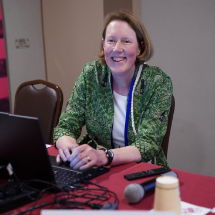
Featured photo by METM26 photographer Giancarlo Menghini.
Thanks for this, Joy! I feel like I’m back at Maria’s excellent talk. I was inspired by Maria’s approach to tenses, and in addition to coming away with a useful way to think more purposefully about tense use and variation, I also came away with an idea for a proposal for METM27. (No idea yet if it has legs, but I’ll give it a go.)